
In its Judgment of 23 December 2024 (not published), Commercial Court No. 1 of Barcelona (now Court No. 1 of the Commercial Section of the Barcelona Court of First Instance) confirmed the importance of interpreting the scope of patent protection in accordance with the description and drawings, as required by Article 69 of the European Patent Convention and its Protocol on Interpretation.
The proceedings involved several companies in the defence sector, arising from the defendants’ participation in a tender launched by the Spanish Civil Guard with a product that was ultimately declared to infringe the claimants’ patent. The product at issue consisted of a firearm holster enabling rapid release while ensuring safety through two distinct locking mechanisms.
These two locking mechanisms are (i) a strap (4) at the top of the holster that is released when the holster button (26) is pressed down, and (ii) a pin (34) that secures the trigger of the firearm and is released (retracted) by pressing the same button (26) on the holster:
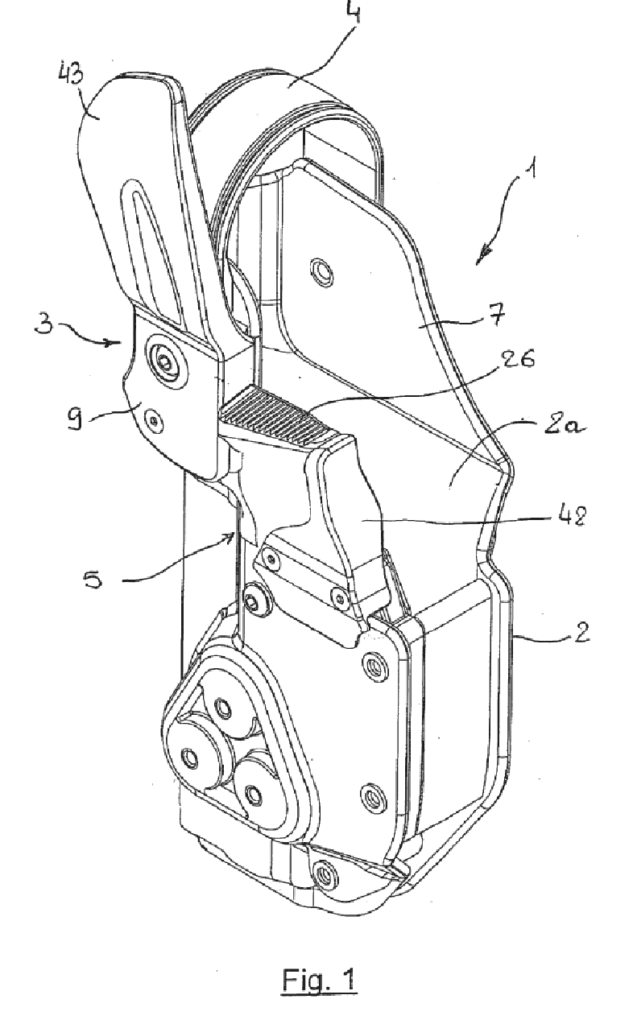
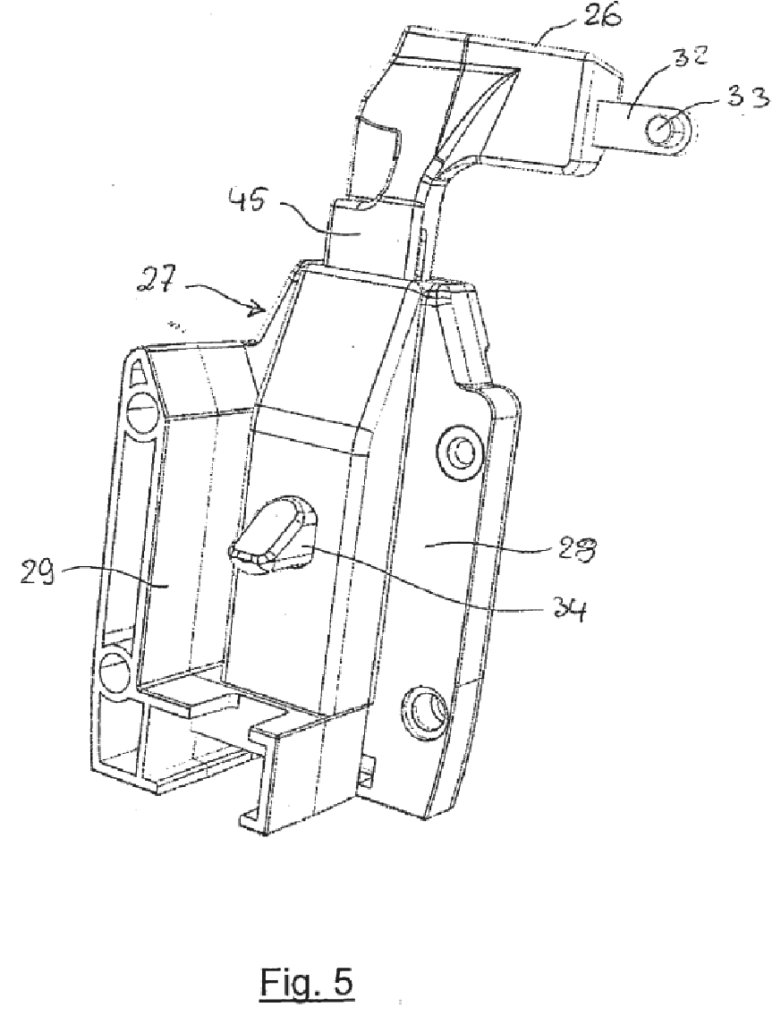
The legal dispute focused on the interpretation of two technical features of claim 1 of the patent: (i) the first concerned the interpretation of the terms “progressive increase in pressure” on the button (26) to release the holster’s locking mechanisms; and (ii) the second referred to the interpretation of the terms “a single sliding direction” of the button to release both locking means of the holster. The defendants argued that their holster did not infringe because it did not reproduce these two features.
In order to interpret these features, the Court first turned to the patent description.
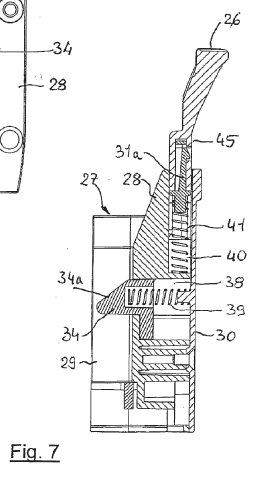
Regarding the progressive increase in pressure (i), the Court confirmed that, since the holster button is positioned beneath a spring (41) and must overcome the resistance of said spring (41) by pressing the button downwards to release the locking means, the progressive increase in pressure did not have to be linearly upward. It could, instead, present fluctuations. This is because, when the spring is compressed by the pressure exerted upon it, there comes a point at which its resistance is overcome and a sudden release of energy occurs, allowing the first locking means to be released. Thus, the pressure first increases and then slightly decreases due to that sudden release of energy. If the button continues to be pressed down to release the second locking mechanism, the same occurs, as pressure is exerted on the same spring (41), which will reach a point of maximum tension and, when another sudden release of energy occurs, will retract the pin from the holster and allow the firearm to be removed. Below is an image from the patent showing the spring (41), which is located below the button (26):
The fact that the progressive increase in pressure did not have to be linearly upward was further confirmed by the description, which also contemplated the possibility of releasing the firearm in two separate operations. In other words, pressing the button once could release the first locking mechanism (the strap), and pressing the same button a second time could release the second locking mechanism (the trigger pin). Therefore, the pressure initially increased and then decreased to zero in each operation, yet still constituted a “progressive increase in pressure” within the meaning of the patent.
The common general knowledge of the person skilled in the art also taught that when the resistance of a spring must be overcome and it is compressed to the point where its elastic reaction is dominated, a sudden release of energy occurs, which may lead to the aforementioned pressure fluctuations. This is known as Hooke’s Law.
As for the sliding direction of the button (ii), the Court also verified in the description that when the patent referred to “sliding”, it referred only to the action of pressing down on the button to overcome the resistance of the aforementioned spring (41). Any other movement to release the locking means was not a slide in a single sliding direction according to the patent. Therefore, although the defendants argued that their holster had an additional (perpendicular) movement to release it, that holster nevertheless reproduced the single sliding direction feature of the patent.
These conclusions of the Court were further supported by the expert opinions submitted in the proceedings and, in particular, by laboratory tests demonstrating that the pressure applied on the holster buttonn was always increasing in accordance with the teaching of the patent, even though fluctuations could occur when both locking means were released.
This judgment is not yet final, as the appeal filed by the defendants is pending resolution.